
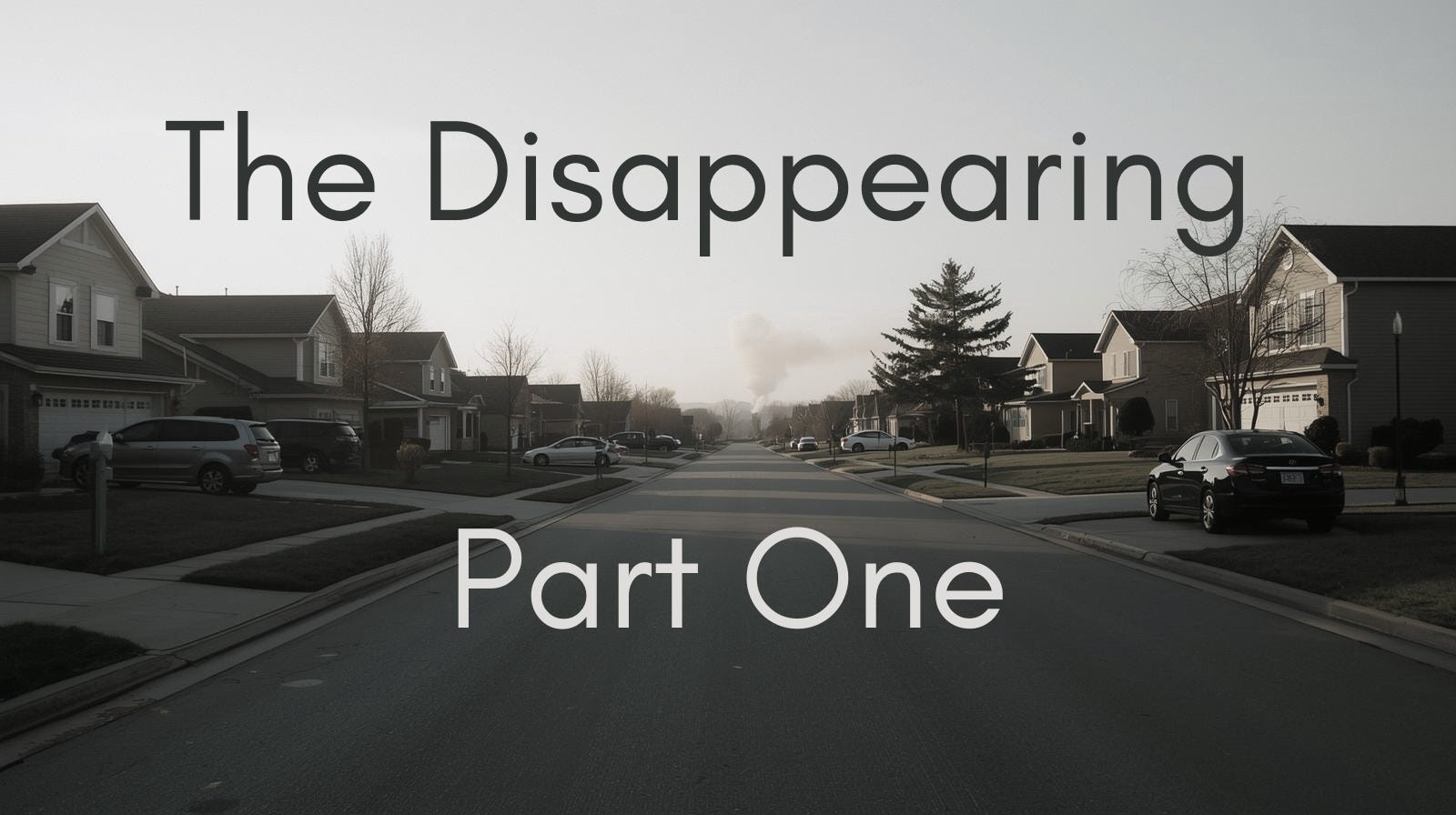
The Disappearing: Part One
The grown-ups are never coming back.

AARON
They called it Disappearing, and what it meant to Aaron was this: The grownups were never coming back. It was illogical, unexplainable—every grown-up in the whole world disappearing, all at the same time. To Aaron, that meant there was no logical reason to expect them to come back. They’d been erased, deleted, canceled from existence.
The grown-ups were never coming back, but the Big Kids were. Aaron watched for them, peered out the upstairs window, careful not to disturb the blinds. His blue eyes could clearly spot the dust kicking up across the abandoned development. Even in the blinding, grapefruit and gold light of the dawn, it was easy to see movement when the rest of the world was so still.
Aaron stared across a barren field, watching puffs of yellow dust erupt and fade. He bent to the sketchpad resting on his knees and added the dust to his drawing. Aaron drew everything that held his attention, everything he didn’t understand, everything he feared. Drawing was like counting for Aaron — it gave his thoughts a structure, a place he could put them and look at them and, sometimes, make sense of them.
In Aaron’s sketch, phantom cows hid in the thick tower of black smoke rising from the horizon. There had been a cattle farm, and for most of Aaron’s short life, the field had buzzed with the secret lives of cows and insects, songbirds and hawks. He’d grown up with the smell of manure and hay baking in the sun. He and his sister had counted the calves every spring, but last year the land had been sold, and construction had started on a new neighborhood.
The neighborhood would never be finished now. Their backyard had been spoiled for nothing, and everything outside smelled like death.
At least if there were cows, we could learn how to take care of them. Then we’d have milk. Some part of his brain, the part that had started to grow up, told him that this was a stupid idea. He needed to focus. Aaron liked to solve problems one at a time, and now the problem was that the other kids were going to come back. He put the bigger questions—how he and his sisters would get food, what if one of them got sick, what if there was a nuclear explosion nearby—into separate boxes in his mind. Visualizing the boxes gave Aaron control over his brain.
He disappeared the smoky cows with a few quick smudges of his pencil. He didn’t like thinking about the cows, or the field, or where his parents had gone.
Aaron turned to Anna and wasn’t surprised to find her right behind him, sucking on a lock of hair.
Anna and Aaron were born nine minutes apart. Anna was technically older, but they didn’t fight about it the way some twins did. They were the oldest of four, and they ruled over their younger siblings with a singular will and determination. Every day since the Disappearing, Aaron and Anna had been learning, slowly and painfully, what it meant to be the caretakers of themselves and their young siblings.
“They’re coming back,” he whispered. “We should go.”
He touched the black box by his side, just once, like a good luck charm. Dad’s gun wasn’t loaded; the bullets were kept in a separate locked box. Aaron had found the keys on his dad’s keyring, still sitting on the bathroom counter, where he always left them in his rush to get ready in the morning. Aaron kept the boxes locked and the gun unloaded, but he had taken the keyring and clipped it to the belt loop of his pants.
He touched the box once more and waited for what his sister would do.
Anna’s eyes, lighter than Aaron’s and flecked with green, moved across the length of the playroom to where their younger siblings slept on the floor. Gwen wore a pink Pusheen nightgown and lay curled around a stuffed dog that once had been pink but had faded to a dishwater gray. Bella, the baby, slept on her stomach, her mouth open and puckered from sucking her thumb. A clear thread of drool ran from her lower lip onto the pack-n-play’s sheet.
The little ones had to be kept safe. It was their job, now that their mom and dad had Disappeared.
“Bella will be hungry when she wakes up,” Anna whispered, relinquishing her mouth’s hold on her hair. It was an answer, and it wasn’t. The kind of ambiguity Aaron hated, and that lately Anna seemed to prefer. He sighed and returned his gaze to the cloud of dust moving toward them.
ANNA
She looked back at Aaron. He straightened his shoulders and lifted his chin, but Anna saw the fear in her brother’s blue eyes.
Aaron looked through the blinds. A soft, frustrated sigh puffed out his lips. “They know we’re here. When they come back ….” He nibbled at his lower lip. Anna stared at the blue rubber bands of Aaron’s braces and wondered who would remove the metal brackets when the time came. Who would finish fixing the front tooth that had come in crooked after a bike accident had shoved his baby tooth out too early? Would Aaron grow up with braces on his teeth forever?
Will he grow up at all? Will any of us?
Lately, Anna had trouble thinking about what Aaron called the Right Now problems. She kept thinking about the future. Or, really, she kept thinking about the fact that there wouldn’t be a future.
“Are you sure they’re coming here?” she asked.
Aaron nibbled his lip again, absently sketching on the paper on his lap. Anna knew he was putting this problem in a box called The Big Kids and opening up a box called Gwen and Bella. She had always understood how her brother’s brain worked, even when no one else did and it was so different from her own. It was like she could physically feel the boxes in her own head, could read the labels on them. She just couldn’t do anything with them.
They stared at each other, arguing their two positions without saying a word. Aaron wanted to run away; Anna knew there was nowhere else to go.
“Maybe they’ll go somewhere else,” he finally said, but he wouldn’t look at her when he said it.
Anna shook her head, pulled her matted blond hair out of its ponytail. By the time she remembered to brush her hair, it had been too late. She nervously pulled the hopeless tangle out of its scrunchy holder, tugged at a few strands, and rewrapped it behind her head. “Keep an eye on them. I’ll get breakfast.” Aaron nodded and returned to the window. Anna unlatched the swinging door at the top of the stairs and descended into the living room.
She stopped at the foot of the stairs, listening. The house was silent in a way she’d never known before. The television wasn’t on, the ceiling fans were still, even the clock on the stove was out. There was no traffic outside, no lawn mowers, no parents yelling for kids to come inside, to get ready, to stop acting like children. She hadn’t realized how much noise the grown-up world made until it had stopped.
She walked into the kitchen and opened the cupboard. The first night, Anna had kept everyone’s spirits up with a celebration. “No parents,” she’d said, standing on the dining room table with a kitchen spoon in her hand, “No problem!” They’d had a dance party, asking Alexa to play all their favorites. Aaron had wisely suggested they eat as much of the fresh or refrigerated food as possible. Anna served leftover pizza with fresh fruit and carrot slices. She put the ice cream in giant bowls and drizzled chocolate syrup all over them, except for Aaron’s. He hated chocolate.
Afterward, Anna had crawled into a bubble bath with Gwen and Bella. Aaron had refused; they were just on the precipice of puberty, and Aaron was self-conscious of his body compared to his three sisters. Anna didn’t understand what the big deal was—they both were just starting to grow hair on their armpits and Anna’s chest had small, painful bumps her mom had playfully called “boobie buds.” Still, she didn’t argue when he’d opted for a shower alone. She’d helped Gwen brush her teeth, and then they’d snuggled in their parents’ oversized bed. Aaron, who was a better reader than she, read them the first chapter of Harry Potter and the Sorcerer’s Stone.
“But where is Mommy and Daddy?” asked Gwen, and she squeezed Anna’s arms the way she did to their mother when she needed comfort.
Anna had kissed the top of her little sister’s head and didn’t look into her eyes. “Don’t worry,” she’d said. “They’ll be home in the morning.” She hadn’t known it was a lie, not then.
The electricity stopped two days later, and there were no more dance parties. Anna had been surprised by how much she’d missed Alexa. It was the last grown-up voice in her world. That was when she knew Aaron was right—the adults were gone. Disappeared. Forever.
Anna pulled out a box of fruit and cereal bars, and the half-empty box of Fruit Loops. If the little ones ate a cereal bar, she’d let them have cereal. She put the boxes on the counter and turned on the sink.
Nothing happened.
The faucet was open, but nothing came except more of the smothering silence that wrapped around the entire house.
The water was gone.
Frustration bloomed inside Anna, a toxic vine that pulled her breath into short, shallow pants. Whatever the grownups did to keep the water running had stopped.
How did water get into the sink, the bathtub, the hose? How did water get from one place to another?
“Shit,” said Anna, then looked around. Before the Disappearing, someone in her house would have called out “Cuss Bucket!” and Anna would have had to surrender a dollar of her allowance, write her name on the bill, and drop it into the big mason jar on the top of the refrigerator.
“Shit,” she said again, because no one was going to tell her not to. Ever again.
Her gaze landed on the family portrait in the entertainment center. Her mother’s bright green eyes, her father’s deep blue ones. They both smiled at her, and in the picture she and all her siblings were nestled in the space created by their parents. Now they were gone, and Anna had no one to hold her. No one to tell her not to swear, and no one to fix the water so they could bathe, brush their teeth, flush the toilet, or get a drink when they were thirsty.
“Shit,” she said a third time. “Aaron,” she called in a whisper. “Aaron!”
His face appeared at the door at the top of the stairs. “What’s up?”
“The water is off,” she said. “There’s no water.”
Her brother ran a hand through his shaggy blond hair. His hair was too short to tangle like hers, but he still needed a haircut. Of course, there was no one to drive him to Cookie Cutters, and no one there to cut his hair. She thought about her brother with hair as long as hers. She smiled, they’d really look like twins, all stick limbs and dirty, moppish hair.
He’d look like a girl, at least until he grew facial hair.
He’ll never grow facial hair, dummy. He’ll Disappear first.
Anna shook her head. She didn’t know that. Wouldn’t believe it.
Aaron snapped his fingers and grinned, bringing her attention back to him. “Dad keeps water in the garage. There’s loads of it. In case of a hurricane.” He thought for a moment, then smacked his forehead dramatically, “There’s probably food in there, too. I can’t believe I didn’t think of it until now.”
Anna nodded, then turned and walked toward the front of the house. It was nice, how Aaron could focus on solving problems, and not on the fear and loneliness that was threatening to eat her alive. His logic had always made her fears seem smaller, sillier. When she’d been afraid of the dark, Aaron had calmly told her there was nothing there that wasn’t there in the light. He’d done experiments to prove it, standing in the middle of their bedroom while she turned the lights on and off. On and off. Darkness and light. Nothing changing but her perception, her ability to see.
She reached the foyer when a knock at the front door stopped her cold.
Possibilities roared through her brain, loud like a big sixteen-wheeler on the highway. What if it was Mom and Dad? No, that was stupid. They wouldn’t knock. The police? Neighbors? What Anna wanted, more than anything, was to believe it was an adult behind the door. A grown-up who would come in, clean the house, turn the water back on, and take responsibility for her and her siblings.
But, Anna thought, putting one foot behind the other and standing on her toes, it could be one of the other kids. They wanted food, water, and money, which Anna knew was stupid. Without grown-ups, money was useless.
The kids also wanted weapons, and other things Anna didn’t totally understand and definitely didn’t want to think about. She bounced on her toes, skittish as a rabbit caught in the open.
The knock came again, softly. Anna shook her head and pulled a strand of hair into her mouth, sucking on the stiff, salty tangle.
It might be Phoebe, thought Anna, and took a step backward. She knew it was wrong, but she didn’t want to see Phoebe after yesterday. They’d watched from the window, but they hadn’t gone out to help when the other kids had circled her. She’d gone into her house with them, and they hadn’t seen her since.
Anna began to pant again, her eyes rolling in their sockets. She turned, her body coiled, ready to spring up the steps.
“Anna, it’s me. It’s Minnie.”
“Minnie,” Anna squeaked. “Oh, thank God.” She ran to the door, still on her tiptoes. She opened the door, and Minnie leapt inside. The other girl’s hair was a dark thatch of tangles, and her usually nutty complexion was so pale her freckles looked like dirt splattered across her nose.
They hugged for a moment. “I was so scared,” Minnie whispered. “I’ve been all alone and then … after yesterday … .”
Anna pulled away. Reflexively, she looked to the stairs, listening for her little sister. She turned back to Minnie, rested her hands on the other girl’s shoulders. “Have you … have you seen her?”
Minnie shook her head. When she looked at Anna, she bit her lip. Her front teeth were large for her face, which gave her a kind of chipmunk look that grown-ups loved, and Minnie hated. “That’s why I came over. I thought we could … maybe, you know, if we — if we’re together ….”
Anna sucked on a new strand of hair and shook her head. She didn’t want to go check on Phoebe. She didn’t want to look into Phoebe’s eyes and know she had been too afraid to help her friend.
But, of course, she had to go. Phoebe lived across the street. She couldn’t avoid her forever. The girls stared into each other’s frightened, exhausted eyes, and Anna nodded.
Minnie smiled. “Great! Uh, do you guys have anything to eat?”
Anna curled the wet lock of hair around one finger and considered Minnie. They had food, but there were four of them. Minnie’s entire family — her mom and stepdad, her older sister, and her step-brother — had all disappeared. Shouldn’t there be food at her house?
As if reading her thoughts, Minnie crossed her skinny arms in front of her chest and lifted her chin angrily. “My mom was going to the grocery store the day … the day it happened.” At the mention of her mother, her anger deflated. She put her head down and scuffed one sneaker against the wood floor. “All that’s left is dried pasta and rice and shit like that.”
“Cuss bucket,” said Anna, without thinking. When Minnie laughed, Anna laughed too. She felt strange, jittery, but happy, like she’d drunk too much soda.
The baby cried from upstairs. Aaron’s voice floated down, “Anna?”
“It’s okay,” she called back. “It’s Minnie. She’s coming over for breakfast.”
Anna and Minnie brought up bottles of water and cereal bars. They mushed one of the bars up for Bella, who ate and drank greedily. It wasn’t until Anna’s belly was full and she was watching the others eat that she thought about Aaron, sitting in the loft, listening to the sound of the knock at the door. He’d never made a sound.
Love the worldbuilding in this piece, it's so vivid and tangible. Can't wait to read the next part!